


Page 21 - Delcampe Collections classiques EN-005
P. 21
Stamps


        the  other to the  West.  The  soldiers
        conquered  the  Ebro Valley then joined
        forces before Zaragoza.  Unfortunately
        for  Charlemagne, they were not  suc-
        cessful:  the city’s  old Roman  walls  re-
        sisted the assaults of the Franks.
        The conquest of the Spanish territories
        was not yet solid. It took six  new ex-
        peditions  over the following 30  years,
        between 797 and 812 to finally assert
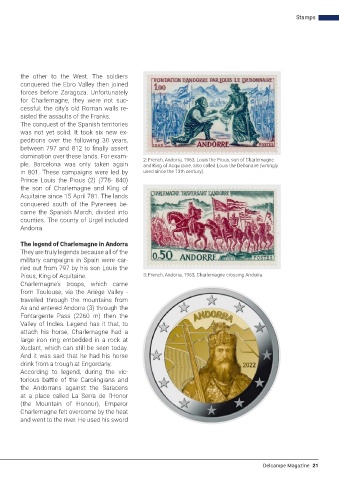
        domination over these lands. For exam-     2: French, Andorra, 1963, Louis the Pious, son of Charlemagne
        ple,  Barcelona was only  taken again      and King of Acquitaine, also called Louis the Debonaire (wrongly
        in  801.  These campaigns  were led by     used since the 13th century).
        Prince  Louis  the Pious  (2) (778-  840)
        the son of Charlemagne  and  King of
        Aquitaine since 15 April 781. The lands
        conquered south  of  the Pyrenees be-
        came  the  Spanish March, divided  into
        counties. The county of Urgel included
        Andorra.

        The legend of Charlemagne in Andorra
        They are truly legends because all of the
        military  campaigns  in  Spain  were car-
        ried out from 797 by his son Louis the
        Pious, King of Aquitaine.                  3: French, Andorra, 1963, Charlemagne crossing Andorra.
        Charlemagne’s  troops,  which came
        from  Toulouse, via the Ariège  Valley -
        travelled  through the  mountains  from
        Ax and entered Andorra (3) through the
        Fontargente Pass  (2260  m) then  the
        Valley of  Incles.  Legend has it  that,  to
        attach his horse,  Charlemagne  had  a
        large  iron ring embedded  in a  rock at
        Xuclant, which can still be seen today.
        And it was said that he had his horse
        drink from a trough at Engordany.
        According to  legend, during  the vic-
        torious  battle  of the Carolingians  and
        the Andorrans against the Saracens
        at a place called La Serra de l’Honor
        (the  Mountain  of Honour), Emperor
        Charlemagne felt overcome by the heat
        and went to the river. He used his sword


                                                                                             Delcampe Magazine 21

