


Page 27 - Delcampe Collections classiques EN-004
P. 27
Stamps


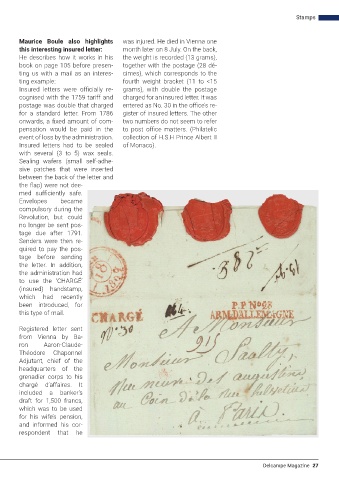
        Maurice  Boule  also  highlights    was injured. He died in Vienna one
        this interesting insured letter:    month later on 8 July. On the back,
        He  describes how it works in his   the weight is recorded (13 grams),
        book on page 105 before presen-     together with the postage (28 dé-
        ting us with a mail as an interes-  cimes), which corresponds to the
        ting example:                       fourth weight  bracket (11 to <15
        Insured  letters  were  officially  re-  grams), with double the postage
        cognised with the 1759 tariff and   charged for an insured letter. It was
        postage was double that charged     entered as No. 30 in the office’s re-
        for a standard letter. From 1786    gister of insured letters. The other
        onwards, a fixed amount of com-     two numbers do not seem to refer
        pensation  would be  paid in the    to  post  office  matters.  (Philatelic
        event of loss by the administration.  collection of H.S.H Prince Albert II
        Insured  letters had  to be  sealed   of Monaco).
        with several (3 to 5) wax seals.
        Sealing wafers  (small  self-adhe-
        sive patches that were inserted
        between the back of the letter and
        the flap) were not dee-
        med  sufficiently  safe.
        Envelopes     became
        compulsory during the
        Revolution,  but  could
        no longer be sent pos-
        tage  due after 1791.
        Senders were then re-
        quired to  pay  the pos-
        tage  before  sending
        the  letter.  In addition,
        the administration  had
        to use the ‘CHARGÉ’
        (insured)  handstamp,
        which had recently
        been introduced, for
        this type of mail.

        Registered  letter sent
        from Vienna by Ba-
        ron     Aaron-Claude-
        Théodore    Chaponnel
        Adjutant,  chief of  the
        headquarters  of the
        grenadier  corps to his
        chargé  d’affaires. It
        included a banker’s
        draft for  1,500  francs,
        which was to  be used
        for his wife’s pension,
        and  informed his cor-
        respondent  that he


                                                                                             Delcampe Magazine 27

