


Page 26 - Delcampe Collections classiques EN-004
P. 26
Stamps


                                 In his book, among the very beautiful    viated form,  failing which an unequi-
                                 letters  featured, Maurice  Boule pre-   vocal term (for example “troops” in the
                                 sents the army postmarks.                Netherlands) was used to inform  the
                                 During the  Italian campaign, the        postal and other services which speci-
                                 General-in-Chief organised how the post   fic military tariffs were applicable. Post-
                                 office was run down to the smallest de-  marks were  also used to show where
                                 tails, which revealed his innate sense of   they were added and in order to differen-
                                 organisation  in  all  fields,  as  evidenced   tiate between them, if necessary (mana-
                                 during  the consular  and imperial  pe-  gement of returns,  déboursés and  ac-
                                 riods.                                   counting, etc.). Each office was unique.
                                 The    First  Consul    created    the   In order to identify it with certainty, large
                                 “Government  Couriers”  on  12  October   armies could mention the number of a
                                 1802,  which  were  reserved  for  official   corps, division, etc. This was no longer
                                 correspondence only  and replaced by     the case in the Grande Armée or other
                                 the “Estafettes” who travelled  across    armies, where  numbers  seem  to have
                                 Europe from Lisbon to Moscow during      been randomly allocated.  In principle,
                                 the 10 years of the Empire.              each office had three postmarks:
                                 There were two types  of mail: stan-     • One for ports dus (PD, postage due);
                                 dard  and  special  mail.  The  first  cate-  • One for ports payés (PP, postage paid);
                                 gory included all routine  letters.  The   • One for déboursés (DB).
                                 second category (special delivery) was   On page 96,  this  letter  bears  the army
                                 primarily  used by army  staff, generals,    postmark.
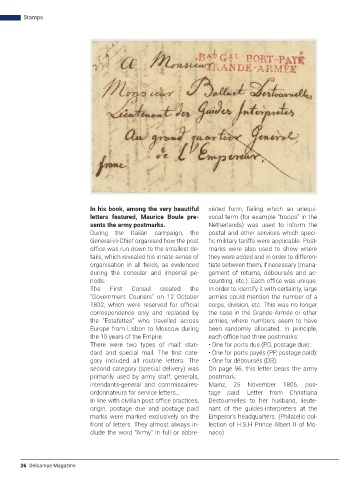
                                 intendants-general and commissaires-     Mainz,  25  November 1806,  pos-
                                 ordonnateurs for service letters…        tage  paid.  Letter from Christiana
                                 In line with civilian post office practices,   Destournelles  to her husband,  lieute-
                                 origin,  postage due and postage paid    nant  of the guides-interpreters at the
                                 marks were  marked  exclusively on the   Emperor’s headquarters. (Philatelic col-
                                 front of letters. They almost always in-  lection of H.S.H Prince Albert II of Mo-
                                 clude the word “Army” in  full  or  abbre-  naco)


        26  Delcampe Magazine

