This is a grave stone at Tweedmouth Parish church. The information provided on http://www.lner.info/ courtesy of "Berwickspotter".
The spelling of Willington as Wellington and the number of the locomotive 184 instead of 104 are thought to be stone mason's errors.
Here is a newspaper report on 5 March 1853
The accident seems to have taken place 90 yards west of the viaduct when a train going towards Newcastle, entered a section of track that was being repaired, left or dislodged the rails and went down the embankment on the south side of the line. It seems as if on account of an earlier train running late the locomotive on the derailed train was a heavier locomotive than normally operated on the line, and maybe this explains why it was a Tweedmouth based driver. It may also be that the drivers of the 3 locomotives that normally operated the line were aware of the repairs and would know to slow down.
The accident happened 15 years after the line was open when repairs were starting to be necessary. Given the comments made by the inspector, this accident may have been influential in changing the practices of the railway company, if not more widely.
The inspectors' reports about the accident provide a lot of detail about the operation of the line in the early 1850s. It seems that the railway did not have sleepers as we know them today but the rails were laid on continuous wooden beams with occasional cross ties. This seemed to be a low cost solution for light railways and the inspector was amazed that the guage between the rails stayed so constant. He suggested they might have got away with this because the line is so straight, but he recommended that the line be upgraded with a better standard of track.
It appears, from this report, that the train to which the accident occurred left the rails, in consequence of being driven at a high speed over a road which was under repair, which should only have been travelled over with great caution; and that the driver received no caution as to the state of the road.
On this subject my Lords desire me to observe, that it appears to them that the system of management on the York, Newcastle, and Berwick Railway must be most reprehensible, under which it is possible for an engine-driver to proceed along any part of the railway with his engine without any caution or warning when the road was under repair, and in the state described in the report, there being a quantity of ballast heaped up between the rails, having among it a number of loose stones of considerable size, and many of the chairs being only secured to the sleepers by single pins, which, in several cases, were loose the road being, as the inspecting officer describes it, in a transition state. The condition of the road here described being one which must, to a certain extent, frequently occur upon all railways, which have been in use for any length of time, and therefore require renewal, it appears to their Lordships that the company should have provided in their system of management for a contingency of this nature, which must be of frequent recurrence upon different parts of the numberous lines of the York, Newcastle, and Berwick Railway Company; and that whatever rules are adopted should be strictly enforced, so that it may become impossible for engines to proceed along the railway whilst in such a condition without a warning being given to the driver, a corresponding reduction of speed being made, with any other precautions which may ensue from increased vigilance.
My Lords desire to request that the serious attention of the directors may becalled to the observations in the report upon the permanent way generally of the Tynemouth branch, and to the reasons which have induced the inspecting officer to come to the conclusion that the permanent way as now laid, is not calculated for the heavy engines that work over many of the lines of the York, Newcastle, and Berwick Railway Company; and that unless the company conduct the traffic strictly and exclusively with light engines at moderate speed, the time has arrived when the permanent way should be relaid in a more substantial manner than that in which it at present exists.
My Lords direct me to state, that they will be glad to be informed of the decision of the directors with reference to this subject.
Lastly, I am directed to request that the attention of the directors may be called to the observations in the concluding paragraph of the report as to the deficiencies in the records which are kept of the working of the trains on the Tynemouth branch, and the absence of any reports by the guards of trains, as it appears to their Lordship most desireable and essential for the proper and safe working of trains, that careful records should be kept, and report made, without which it appears to be impossible that the management of the line can be conducted with regularity, and a due regard to safety.
The train to which the accident happened was the four p.m. up train to Newcastle. It consisted, beside engine and tender, of a guard's van and three or four carriages, the van being next to the tender.
The first indication of the engine having got off the rails appeared at a spot about ninety yards on the Newcastle side of the Willington viaduct. The marks were so slight when I visited the spot, that I should not have noticed them had they not been pointed out to me; but about twenty yards further on the timbers were much gashed and the ballast ploughtd up; and it was somewhere about this spot that the enine, dragging with it the tender and van, finally left the line to the left, ran down the embankment which is about twelve feet high, broke through the fence at the bottom, and brought up in the field adjoining. All these were found standing on their wheels, but reversed to the order in which they had been proceeding, viz., facing towards Tynemouth, instead of Newcastle. So much had been done to the line subsequent to the accident, and previous to my visit, in replacing bent and broken rails, and removing a quantity of ballast that had been heaped up between the rails, that personal observation would not allow me to pronouce upon the cause of the accident; but from what was left for my observation, and the evidence I obtained, I have reason to believe that the accident arose from a high speed on a road that was under repair, and which should only have been travelled over with great caution.
It appeared that the company had just completed relaying the down line over the Willington viaduct with a new set of rails on longitudinal timbers of whole balks, and they were about commencing the relaying of the up line in a similar manner, when they were interrupted by the severity of the weather. The old line over the viaduct was laid with a rail of this section on longitudinal half timbers, to which the rail was secured by wood screws passing through the flanch; but the longitudinal timbers, beside the rail, carried a wooden guard-rail. The consequence of this was, that the iron rail, instead of having a firm bed in the centre of the timber, was set close to the edge, and the timbers having been down fourteen or fifteen years, although they were sound at the heart, yet at the edges they were in many places decayed and split, and the rail had not the firm bed which it ought to have had. From the end of the viaduct, for eighty yards, the line was new laid on cross sleepers, when it joined on to the original old line, the same as that I have described on the viaduct, with the exception of the wooden guard-rail.
From the evidence I was able to collect, it appeared that a quantity of ballast had been heaped up between the rails, and that on the top of this ballast a number of loose stones, some the size of a brick, were lying, and that the ballast lay close up against the edge of the rail; that materials of all kind were lying about; that the cross sleeper line had only lately been laid; that many of the chairs were only secured by one pin, and that of these pins several were loose. The road was, in fact, in a transition state; and from this circumstance the elements of danger in it were numerous, and the greatest caution was required in passing over it. There can be no question in my mind, both from the evidence of individuals and the trace left on the line, that the train was proceeding at a much higher speed than the state of affairs at this spot would justify. The engine was not one ordinarily working on the branch, but had been impressed for the up and down trip in consequence of some delay in the arrival of one of the trains.
It appears from the evidence given at the inquest, that the driver received no caution of the state of the road at the Willington viaduct, and therefore the management of the company has been most seriously in fault.
The permanent way from the junction of the branch with the main line to North Shields, is laid with a flanch rail on longitudinal timbers, the rail being screwed to the timber by wood screws, the parallalism of the line is maintaned by cross timbers dovetailed into the upper part of the longitudinal timber at nine feet intervals, the latter being bedded entirely in the ballast. The line was constructed fourteen or fifteen years ago, and the timbers and rails are those originally laid down; the former are from 10 to 12 inches in breadth and from 5 to 6 inches in depth, and the latter weigh 50 lbs. to the yard. The timbers, externally, had the appearance of being much decayed, but a closer examination showed that this was altogether superficial, as they were quite sound at the heart, and in some of the timbers which appeared worse than others I found it impossible, with a pinch bar placed under the rail to start the screws. Nevertheless, the edges of many of the timbers were split and others rotten, but the decay in no instance extended far into the timber, and appeared to be due to sappy parts of the wood. The timbers are all much worn where the joints of the rails occur, and at these places the worn part had been cut away and replaced with a piece of hardwood; the cross ties or transom I found in a very different state from the longitudinal timbers, being for the most part utterly decayed; this different state of things in timber which has been laid down the same number of years, I find has arisen from the longitudinal timbers having undergone the process of being Kyanized, and the cross pieced having been put down in their natural state; this I consider a very important fact, and is a valuable testimony in favour of the Kyanizing process. It may not be out of place to mention here, that I found the timbers equally sound on the Manchester and Bolton line where the same process had been used, and where the timber had been down about the same number of years. In consequence of the decayed state of the transoms, I found portions of the line varying from 50 yards to 200 yards and upwards in length, without any cross ties; the width of these portions of the line I had carefully measured in several places, and they proved to be in vry accurate guage. The line is, for th most part, straight, and the ballast excellent in quality. That a line laid on longitudinal timbers, having the ties occurring at the long intervals I have named, can be safe, or remain permanently in guage, I can hardly believe. The company at the time of my inspection were engaged in removing the decayed transoms and inserting every 30 yards a sleeper under the longitudinal times and an iron tie-rod intermediately. This arrangement is undoubtedly inferior to the original construction of the line; and when it is considered that although the timbers are still sound at the heart, yet from the decay at their edges and wearing at the joints of the chairs and other places, there can be no doubt that the strength of the timbers must have greatly deteriorated; and though I am not prepared to say that the line is not still safe for the light traffic that ordinarily passes over it, I am satisfied it is not calculated for the heavy engines that work over many of the lines of the York, Newcastle, and Berwick Railway Company; and it is a matter for consideration; whether a company is justified, except under very peculiar circumstances, in keeping up a permanent way that is not calculated for the general traffic of the company, more especially when it is the case, as with this branch, that engines of a heavy class are occasionally sent over it. I am myself decidedly of opinion, unless the company strictly and exclusively reserve the line for a very light traffic with very moderate speed, that the time has come when the permanent way should be relaid in a more substantial manner than that in which it at present exists.
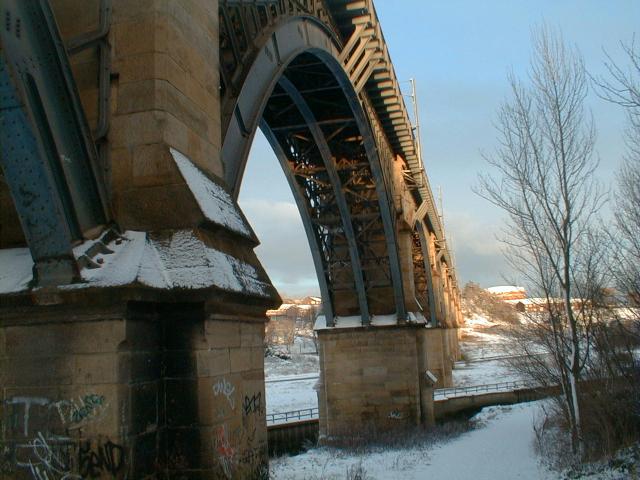
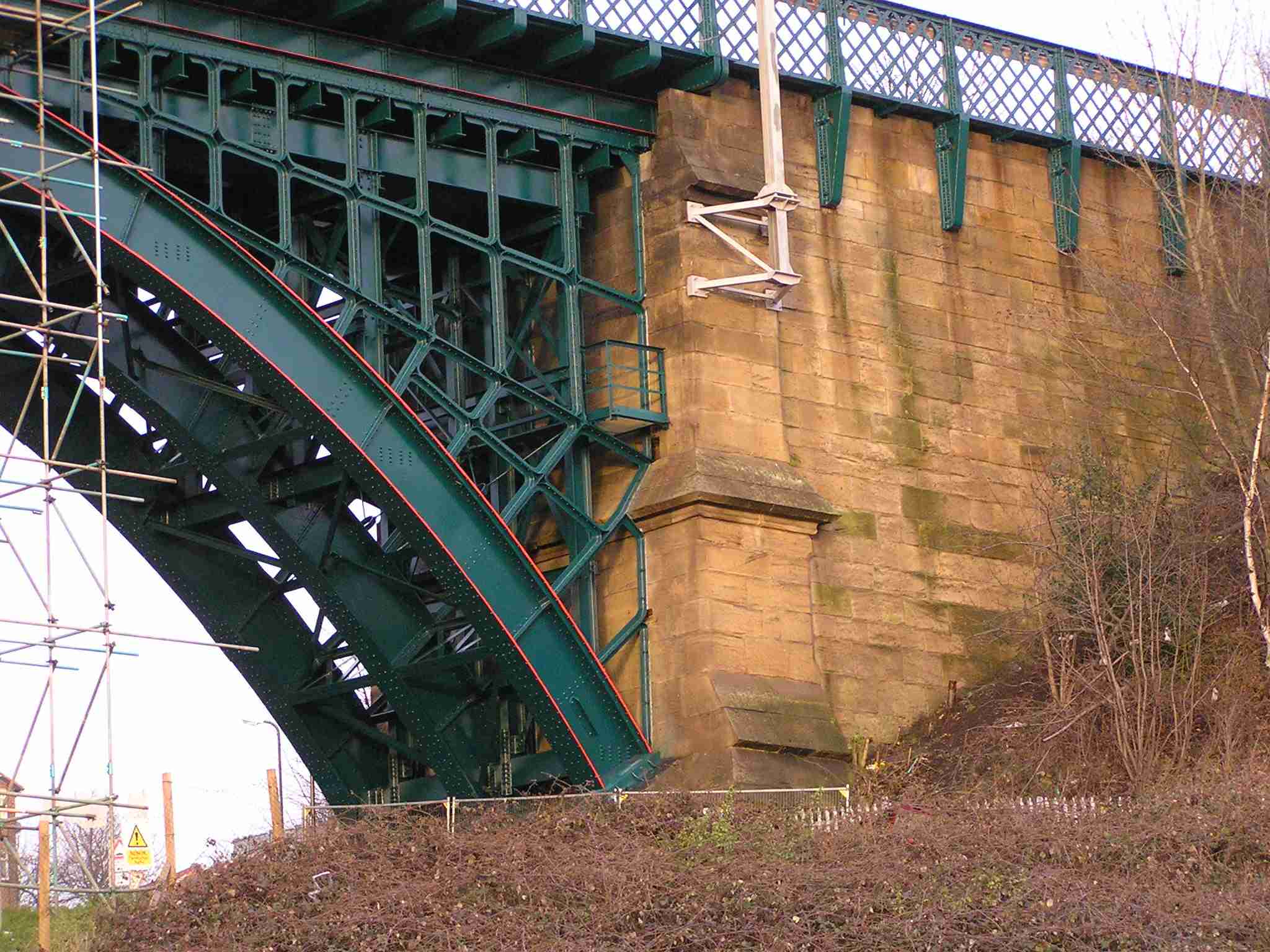
With regard to the Willington viaduct, about the strength of whch some alarm was felt, I am enabled to report very favourably: it consists of seven openings, which are spanned by lamited timber arches of 120 feet span, resting on stone piers. I had one of these arches loaded with three locomotive engines and their tenders, representing a weight of 133 tons, and the deflection I obtained was very inconsiderable. The timber which had been Kyanised I found, both in the arches and superstructure, to be in a perfect state of preservation (which is an additional testimony in favour of this process), and with the new permanent way which has been laid down on the viaduct, I consider it to be a very substantial structure.
The locomotive establishment told off for working the passenger traffic of the Tynemouth branch, may be stated to be four engines, of which thee are daily in steam and one in the shed; the work of each of the three engines in steam averages daily ninety miles. I examined the books of the locomotive department as far back as November, and I found that the passenger traffic during that time has, for the most part, been worked by six engines, I find that two were rebuilt in 1849, two others had new fire boxes and tubes in 1852, besides other extensive repairs; the fifth had new tubes in December, 1851, and other repairs amounting to 538l., and the sixth had undergone repaires in 1849 to the amount, it was stated to me, of 1,370l., including new fire box and tubes and subsequent repairs amounting to 328l. Owing to the absence of some of the books, I was not able to verify all the items of this account, which I as with all the others. From the registered amount of work these engines had done subsequent to the repairs, I have no reason to think that the company is working the Tynemouth branch with a deteriorated stock.
The company's arrangements appear to have been extremely defective for checking irregularites that may have arisen in working the traffic on the Tnemouth branch; no regular written reports are made by the guard, and no record prior to the 16th January was kept of the arrival of trains, and ever since then the register book of their arrival is very defective in stating the cause of delay, which is a very important matter on many accounts to have accurately recorded. The most serious item in the registry book is against No.70 engine, which it appears was four times late between the 26th February and 2d March, chiefly it appears from slipping on the rails, which was ascribed to its not being a coupled engine, as it seems to have slipped with loads not exceeding three carriages, when other and heavier trains were able to proceed, the probability is, that it is not adapted for this traffic, and should therefore be placed on other duty.
Back to Peter and Margaret's Webpage
Last updated: 2 August 2009