Week 2
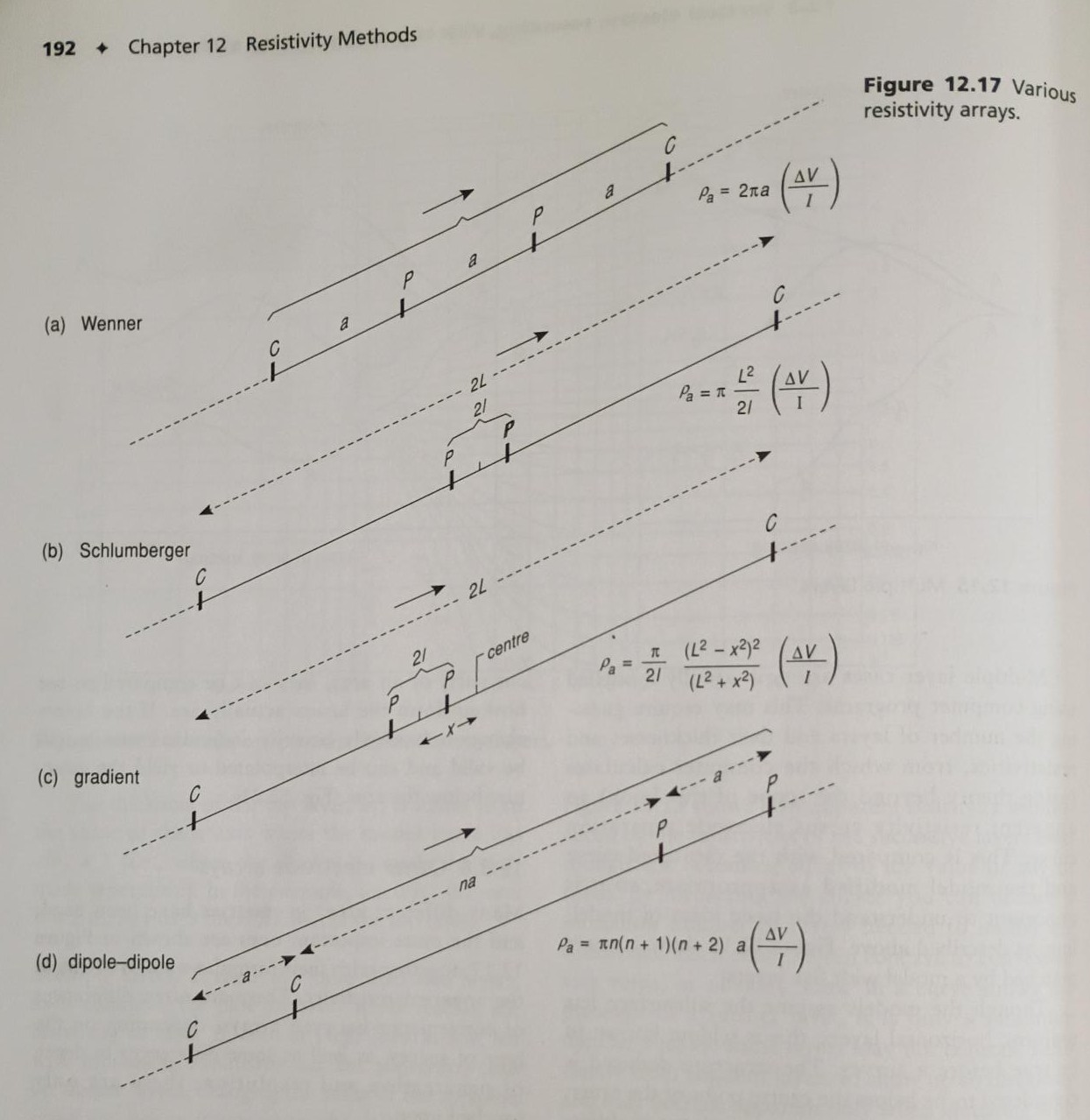
Beginning our discussion of electrical resistivity measurement and geologic interpretation. For now, we will focus on one-dimensional imaging of the subsurface. This is called Vertical Electrical Sounding or VES. There are different geometries, or array styles, you might use to collect VES data. We will examine Wenner VES (W-VES) and Schlumberger VES (Sch-VES) geometries in the field this week at the Dog Leg field site.
Lec: 9/2
A big day with lots of ideas about resistance vs resistivity, demo with various wires, why resistivity and not resistance, Ohm's Law, converting resistance to resistivity ("geometric factor"), measuring current and voltage drop in the field - and then getting resistivity out of it. What is apparent resistivity, making a single electrical resistivity measurement, Wenner array geometry. Circuit Construction Kit: DC, demo with the dry sand vs saturated sand.
So what to do? Try reading through the chapter I passed out in class once again and see if more of it makes sense (maybe not all of it will, that's ok). The good thing is that once you really get the idea of what making one resistivity measurement is about, that's it - all other "array geometry" styles are just different patterns of that measurement.
Lab: 9/3
Basic handout (directions and geologic map) for the Dog Leg Aquifer "Hydrogeolophys" Field Site. Our goal at this site is to understand its structure and potential as an aquifer. Where could we site a groundwater well? How will/might geophysical surveys help us with this? What is our preliminary geologic model of the site? Here is a copy of the field exercise handout.
Other Notes:
Useful images:
{Image from Looking Into The Earth by Mussett & Khan}. Schematic of various array geometries, their names, and the geometric factor,