Purpose of this course in the GEOL Curriculum
Who takes this course?
Geology Concentration students in the EESS major are required to take this course.
Students in geotechnical engineering are highly encouraged to take this course, and other GEOL courses (courtesy of Dr. Robb Moss).
The course can count towards a geology minor. Students from EESS, Civil Engineering, Physics, ENVM often take the course.
Why take (or require) the course?
This course aims to be very practical and employable for you. Some evidence:
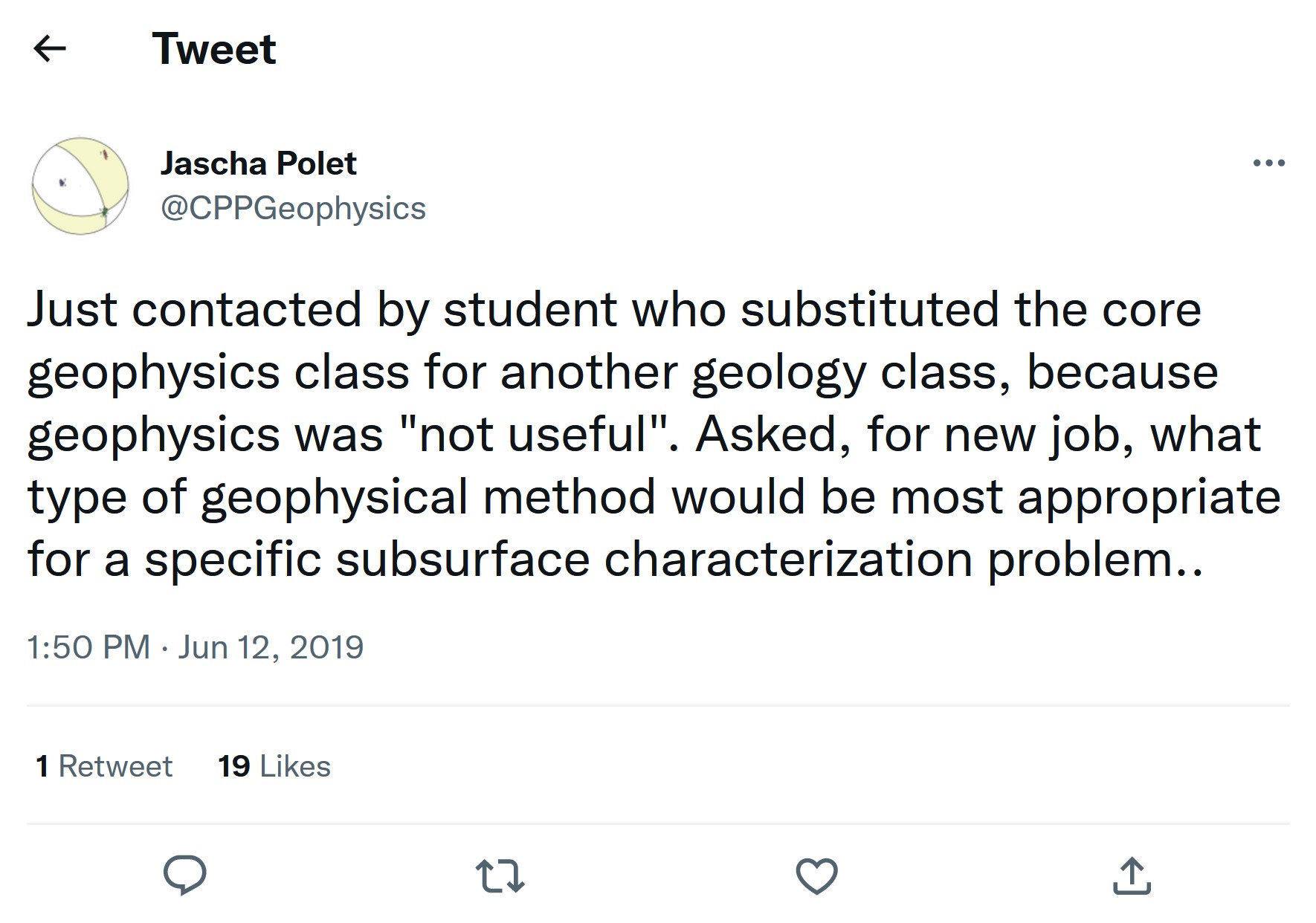
Most geology programs have a course kind of like this one on the books, but few require it. Knowledge of near-surface geophysics can help distinguish you from the other geology students out there you will compete with for employment.
Some (but not all) geologic problems in the consulting industry truly need to use near-surface geophysical data to help solve their problems. Therefore, the topic can help you make money. Fun fact: companies need to make money to hire and pay you.
Even if you work for a government agency (e.g. a county, the USGS, a university), where do you think they get their money from? Hint: look at your paystubs.
Our focus will be to applications in groundwater, which means hydrogeology / hydrogeophysics. This is driven by the ease of finding good field site to study this topic, its obvious relevance, and the large variety of jobs available to geologists in this area.
The other historical primary areas in which geophysics is used is mineral exploration and geothermal exploration. Lately, the field of "critical zone studies" has successfully incorporated geophysical tools as well.
The above topics can be referred to under the umbrella of near-surface geophysics - and this is the area in which this course operates. However, I call the course Field Geophysics because we collect so much of our own non-trivial data to support the course.
Further, obviously the energy industry (e.g. oil and gas exploration) use geophysical tools, and they are responsible for a lot of the technological advances in the field. But their targets are deeper - several kilometers - and this area is referred to as exploration geophysics.
Finally - you do not do geophysics in isolation. This means that the use of geophysical tools is to help solve or think about a geologic question. So think about the material as another tool: just like some problems in structural geology may benefit from a petrology perspective, or a problem in stratigraphy may benefit from a structural perspective, some questions in geology may benefit from a geophysics perspective.
Don't think of the subfields in geology as so distinct - they are just different perspectives on the geologic processes we all love.
On the other hand, even though this course is explicitly meant to be very applied, we can also use the same principles to study the earth for its own sake. My personal background in geophysics is not "applied geophysics" or practical at all — so we will try to sneak in a little bit on some ways in which the same principles can be used to just look inside the earth just for fun. This is referred to as global geophysics. For more on that, see PHYS 4410 — Physics of Solid Earth.
Back to the GEOL 420 Homepage