


Page 53 - Delcampe Collections classiques EN-004
P. 53
Postcards


         100%  aluminium  postcards  first  appeared
         at the start of the century. If you look at the
         back of the postcards, you’ll see they aren’t
         split,  as  was the case in  France prior  to
         1903.
         Aluminium was a very important material in
         France at the start of the 20th century. The
         Maurienne  Valley,  where it  originates,  had
         at least six operating aluminium production
         plants from 1892 to 1907.
         Aluminium is a light and flexible metal. This
         characteristic gave birth to the concept of
         the aluminium  postcard,  which was more
         original  than the paper postcard. Alumi-
         nium postcards were initially made entirely
         from this metal and printed with black ink.
         The motifs varied: realistic and humorous
         drawings and sometimes photos... the back
         of the cards had space for the address and
         a stamp.
         Aluminium  postcards were also used in
         countries  other than France.  In Italy, for
         example, there were aluminium postcards
         at the First International Exposition of Mo-
         dern Decorative Arts in Turin in 1902. Other
         countries also used this unusual means of
         correspondence including  Spain,  England,
         the United States, and more.
         Some artists  earned  their reputation via
         this medium. For example, Achille Beltram
         in Milan…
         100% aluminium  postcards disappeared
         in the  early 20th century, to be replaced
         by “hybrid” postcards. They were made of
         paper but contained some aluminium ele-
         ments, which made them shiny. Quite a few
         embossed fantasy postcards used the pro-
         cess,  notably many postcards for the  ho-
         lidays, like Christmas, Easter, and for April
         1st. Note that aluminium postcards belong
         to the golden age of postcards, a time when
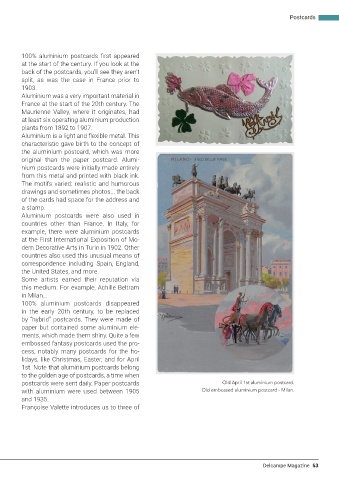
         postcards were sent daily. Paper postcards                            Old April 1st aluminium postcard.
         with  aluminium  were used between 1905                        Old embossed aluminium postcard - Milan.
         and 1935.
         Françoise Valette introduces us to three of


                                                                                             Delcampe Magazine 53

