


Page 41 - Delcampe Collections classiques EN-004
P. 41
The Danes reached  Ceylon in
        1620,  via the Danish East India
        Company.  Since they couldn’t
        come to an agreement with the
        local  population,  they  set  up  in
        Tranquebar and the surrounding
        region, after purchasing the ter-
        ritory.  They built Fort Dansborg.
        The     colony    was     called
        “Danesburg” before becoming
        “Tranquebar” at the beginning of
        the 18th century.
        Tranquebar enabled  the Danes
        to charter boats to bring back
        many spices to Denmark. Howe-
        ver, the colony’s location was
        prone to tidal waves and the
        British East India company was
        becoming increasingly com-
        mercially  important.  Relations
        between the  Tranquebar colo-
        ny and the motherland were so
        complex  that,  during  25  years,
        no boats  went to the colony.
        Overall, the results of the coloni-
        sation of India by Denmark were
        disappointing  and the Danish
        Company’s activities  were ter-
        minated in 1729 in favour of the
        Asiatic Company.
        In addition to its  commercial
        purpose,  in  the 18th  centu-
        ry,  Tranquebar  became  the
        Danish-Halle Protestant mission


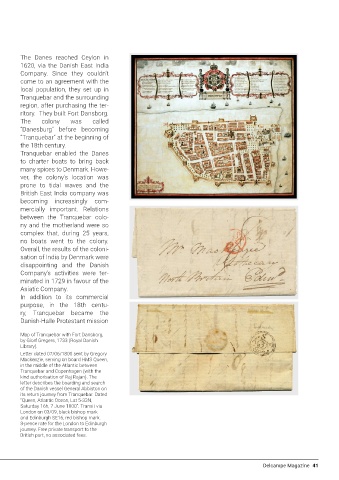
        Map of Tranquebar with Fort Dansborg,
        by Giorf Gregers, 1733 (Royal Danish
        Library).
        Letter dated 07/06/1800 sent by Gregory
        Mackenzie, serving on board HMS Queen,
        in the middle of the Atlantic between
        Tranquebar and Copenhagen (with the
        kind authorisation of Raj Rajan). The
        letter describes the boarding and search
        of the Danish vessel General Abbiston on
        its return journey from Tranquebar. Dated
        “Queen, Atlantic Ocean, Lat 5-33N,
        Saturday 16h, 7 June 1800”. Transit via
        London on 03/09, black bishop mark
        and Edinburgh SE16, red bishop mark.
        8-pence rate for the London to Edinburgh
        journey. Free private transport to the
        British port, no associated fees.


                                                                                             Delcampe Magazine 41

